The 4C Framework of Art Collecting
A simple system to collect, manage, and trade art with clarity -- not guesswork.
A simple answer is that successful art collecting isn't just about buying what you like -- it's about running a system. The 4C Framework (Curate, Context, Control, Circulate) helps collectors build cohesive, well-documented, and strategically managed collections that can grow in value and evolve over time.
4C Framework
- Curate: define your taste and collecting focus
- Context: understand the artwork's market and background
- Control: organize and track your collection and documents
- Circulate: know when to sell, trade, loan, or reposition works
Most collectors don't fail on taste -- they fail on structure
There's a common belief that art collecting is purely instinct: you see something, you love it, you buy it.
That's how most collections start -- but it's also why many collections plateau.
Over time, gaps begin to show:
- records are incomplete or scattered
- values are unclear or outdated
- purchases feel inconsistent
- opportunities to sell or upgrade are missed
The issue isn't taste. It's the lack of a system.
Serious collectors -- whether they realize it or not -- operate with one.
1. Curate (Taste)
Define what belongs in your collection.
This is your foundation:
- What artists, styles, or themes are you drawn to?
- Are you collecting for passion, investment, or both?
- Are you building depth (focused) or breadth (exploratory)?
Your taste is your edge. It's the only part of collecting that's truly personal and hard to replicate.
But without structure, taste alone leads to randomness.
Without curation, you don't have a collection -- you have inventory.
2. Context (Information)
Understand what you're actually buying.
Every artwork sits within a broader context:
- artist career stage and trajectory
- provenance and exhibition history
- gallery representation and market positioning
- comparable sales and demand
Two similar works can have vastly different values depending on these factors.
Context is what turns instinct into informed decisions.
The difference between a good buy and a great one is usually context.
3. Control (Organization)
Track and manage your collection like an asset.
This is where most collectors fall behind.
A well-managed collection includes:
- artwork details (title, medium, dimensions)
- purchase history and pricing
- documents (invoices, COAs, appraisals)
- current location (home, storage, on loan)
- valuation over time
Control creates visibility -- and visibility creates better decisions.
If you can't clearly see your collection, you can't manage it strategically.
4. Circulate (Liquidity)
Know when and how to move works.
Great collectors don't just acquire -- they reposition.
Circulation includes:
- selling or consigning works
- trading or upgrading pieces
- lending to exhibitions
- donating or planning for estate transfer
This isn't about flipping -- it's about maintaining flexibility and direction.
A strong collection evolves. It doesn't just accumulate.
From ownership to system thinking
Most collectors operate heavily in Curate (taste).
More advanced collectors develop Context (knowledge).
But the real shift happens when you build Control and understand Circulation.
That's when collecting becomes:
- more intentional
- more organized
- more valuable (financially and culturally)
The difference is subtle, but important:
A wall of art is static.
A collection is a living system.
Where tools like ArteraQ fit
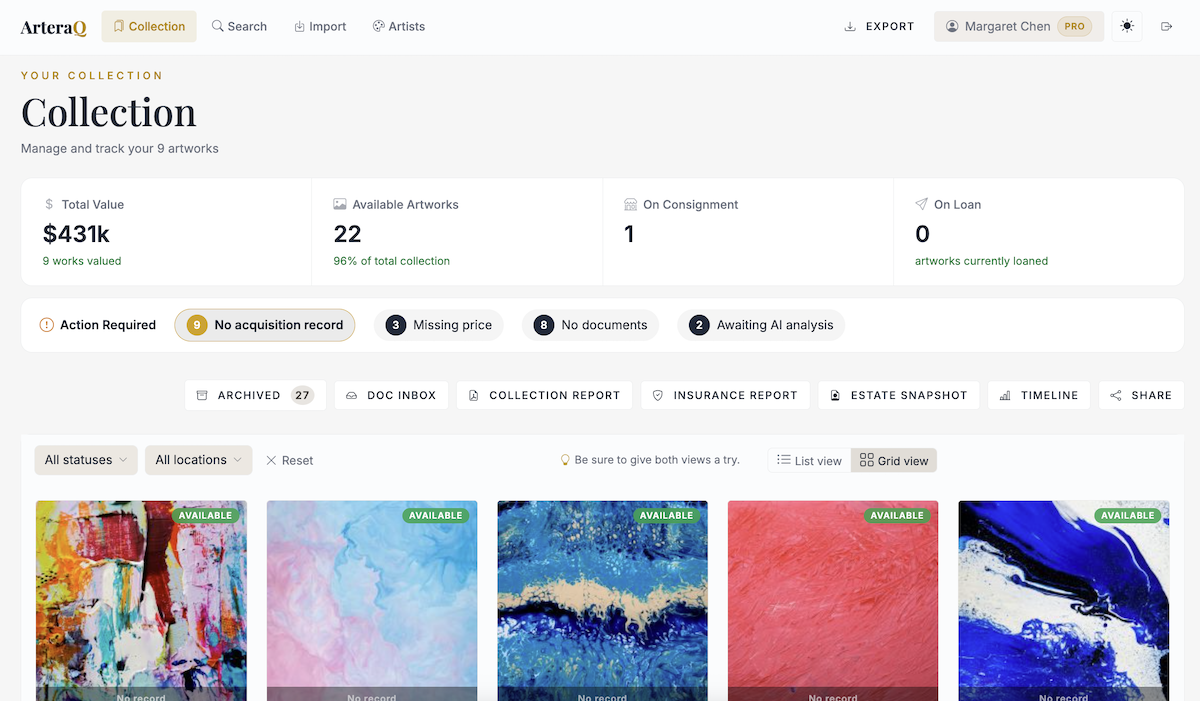
Modern collectors are starting to treat their collections more like portfolios.
That means:
- centralized catalogs
- document management (COAs, invoices, appraisals)
- missing-data prompts ("what you don't know")
- location tracking
- insurance and estate-ready reporting
Because collecting today isn't just about acquiring art --
It's about running the system behind it.
Ready to build your system?
Start organizing your collection with ArteraQ -- free for up to 50 artworks.